At the Township
September 2nd 2026 Board Meeting Cheat Sheet
Never been to a township meeting? Where it is, how it works, when you can speak, what the jargon means, who is in the room, and what every item on tonight's agenda is actually about.
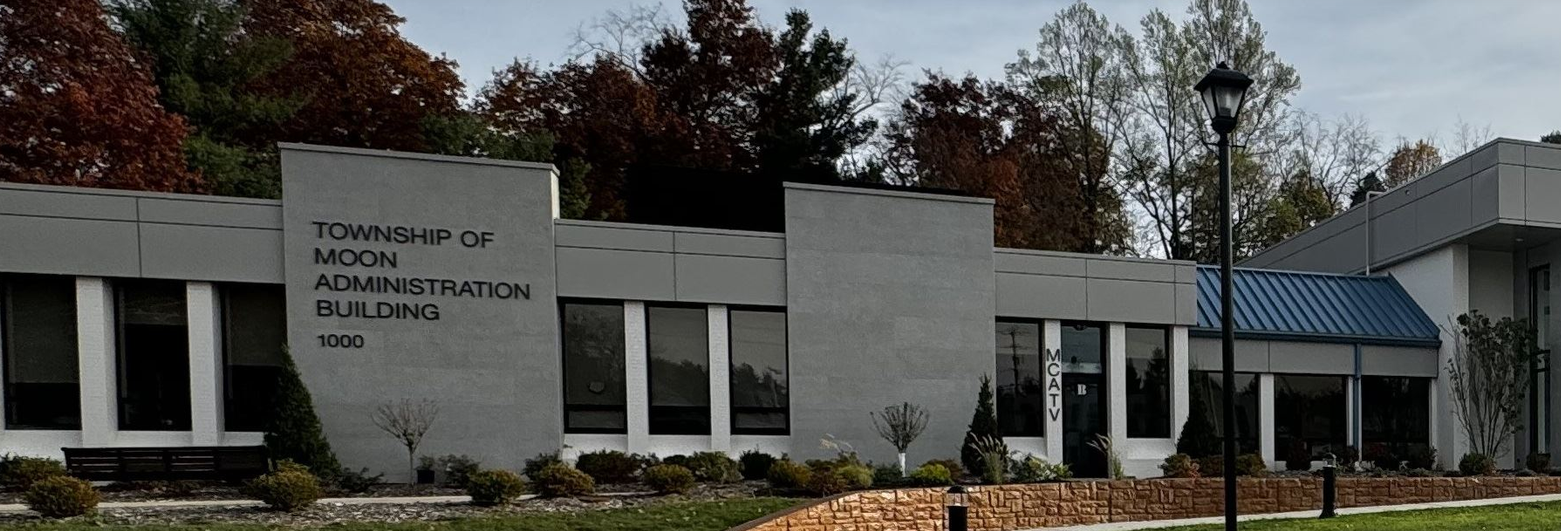
- Tonight, 6:00 p.m., Moon Township Municipal Building, 1000 Beaver Grade Road. Anyone can attend. You do not need to sign up, register, or say anything.
- You get to speak at item 7, near the start — before almost every vote. There is a second chance to speak inside the Apex hearing at item 9.
- Recent meetings have run 26 to 63 minutes. Tonight has a public hearing on it, so plan for longer.
- The big item is a 301-home development off Marketplace Boulevard — but the scheduled motion is to postpone it to October 7.
This page exists so that someone who has never been to a township meeting can walk into this one and follow it. What the room is, how the evening is structured, when you are allowed to talk, what the words on the agenda mean, who all those people at the table are, and what each item is actually about.
What to expect
Where and when. Moon Township Municipal Building, 1000 Beaver Grade Road, Wednesday September 2 at 6:00 p.m. The meeting is public. There is no admission, no sign-in sheet, and no requirement to speak or identify yourself if you just want to watch. Meetings are also filmed by MCA-TV, the township's public-access station, which has been recording them since 1985.
How long it takes. Shorter than people expect. The last four regular meetings ran 26, 39, 43 and 63 minutes. Tonight carries a public hearing and a longer-than-usual action list, so it will likely sit at the upper end of that or beyond — but this is an evening, not a marathon.
The shape of the evening. Every regular meeting follows the same order, and knowing it means you can tell where you are:
- Items 1–5: openings. Call to order, pledge, roll call, an announcement of any private session the board held recently, and a chance to amend the agenda.
- Item 6: presentations. Guests and staff give reports. Tonight: police promotions, a report on the industrial development authority, the library director's quarterly report, and a proclamation.
- Item 7: public comment. This is your slot.
- Item 8: approving past minutes. Housekeeping.
- Item 9: the public hearing. A formal, court-like proceeding on the Apex development, with its own separate public comment section.
- Item 10: action items. The actual votes. Nine of them tonight.
- Items 11–14: manager's report, paying the bills, supervisors' closing remarks, adjournment.
When you can talk, and how. Item 7 is general public comment and it comes early, before nearly all the voting. Walk to the microphone, say your name, and speak. The township's minutes record commenters by name and address — be aware that if you speak, your street address will end up in a published public document. (Moon Pulse does not republish home addresses, but the official minutes do.)
There is no stated time limit anywhere in the public record, though the practical convention at these meetings is a few minutes. You can speak about something not on the agenda. You can also just watch — most people do.
One thing worth knowing: the board frequently does not respond in the moment. Comments are heard, noted in the minutes, and often answered later or not at all. That is normal procedure, not a brush-off.
Who will be there
Roughly a dozen people sit at or near the front. Here is who they are and why they are talking.
The five who vote
Moon Township is governed by a Board of Supervisors — five residents elected by everyone in the township, serving six-year terms under Pennsylvania's Second Class Township Code. They are part-time officials, not full-time politicians, and between them they hold every legislative and budgetary power the township has. Every vote tonight is theirs alone.
- David Bachman — Chairman. Runs the meeting, calls each item, and calls for motions. The chairman is chosen by the other supervisors each January, not by voters.
- John Hertzer — Vice-Chairman. Runs the meeting when the chairman is absent. Nominated for the role by Wise and seconded by Carnahan at the January 2026 reorganization.
- Mary Jo Wise. Also sits on the Library Board of Trustees as a supervisor liaison — worth knowing when the library comes up at item 6.
- Christopher Rolinson. Joined the board in January 2026.
- Paula Carnahan. Also joined in January 2026.
Two seats changed hands this year: through 2025 the board was Bachman, Hertzer, Wise, Albert Quaye and Luanne Vitale. Quaye and Vitale are gone; Rolinson and Carnahan took their places. Two of the five people voting tonight have been doing this for eight months.
The staff who make it run
These people advise, report and answer questions. None of them vote. That distinction matters when you are watching: the person doing most of the talking on a given item is usually staff explaining it, not a decision-maker deciding it.
- Dawn Lane — Township Manager. The township's chief administrator, appointed by the board rather than elected. She runs day-to-day operations and delivers the manager's report. She appears in every single meeting record we hold.
- Marla Marcinko — Assistant Township Manager.
- Scott Brilhart — Assistant Township Manager and Planning Director. The person who reviews development plans and writes the staff reports the board votes on. If tonight's Forest Park or Apex items get technical, he is likely the one explaining.
- Donald Graham — Township Solicitor. The board's lawyer, from an outside firm. He advises on what the board legally can and cannot do — especially during the public hearing, which has formal legal rules.
- Frank Starko — Chief of Police. Presenting tonight's promotions.
- Krista Watt — Finance Director. Handles budgets and the bills.
- The township engineer — an outside firm, Lennon, Smith, Souleret Engineering, usually written as LSSE in documents. They review construction and development plans and write the review letters that conditions get attached to.
Everyone else
Applicants and their lawyers and engineers attend for their own items — expect the Apex development team for item 9. Residents attend to speak, or to watch. And MCA-TV runs the cameras.
The agenda
Fourteen numbered items. Most take under a minute. Five are worth understanding before you walk in, and they are marked.
1, 2, 3 and 5the openings
Call to order, the Pledge of Allegiance, roll call, and a chance to amend the agenda. Roll call is worth half your attention: it tells you which supervisors are present, and a four-person board changes what a split vote looks like.
4Executive session announcement
What it is. The chairman announces that after the August 26 workshop, the board met privately to discuss real estate, confidential personnel matters, and litigation. No vote, no discussion — just an announcement that a closed meeting already happened.
Why it is on a public agenda at all: because Pennsylvania law requires the board to say publicly that it met privately, and to state the reason.
6.APolice promotions
What it is. Chief Frank Starko presents promotions for four officers: Lt. Joseph Brace, Sgt. Devin Small, Sgt. Angela Zane and Cpl. Geoffrey Agreen. Expect handshakes, family in the audience, and photographs.
Is there a vote? No. Promotions come to this board as recognitions, not motions — the board congratulates, it does not decide. This is the warmest ten minutes of the evening and a genuinely nice thing to witness.
These are not new names. All four appear in the township's record under lower ranks, so tonight is a step up rather than an introduction:
- Joseph Brace appears in December 2024 as Detective Sergeant — tonight he becomes a lieutenant.
- Devin Small appears as Detective Corporal — tonight, sergeant.
- Angela Zane appears as Officer — tonight, sergeant.
- Geoffrey Agreen appears in December 2024 as Detective, when Chief Starko presented him a Letter of Commendation for investigative work between October 2023 and November 2024 in the Special Investigations Division, and for "going above and beyond" in assisting other agencies. Tonight, corporal.
The department is growing. In September 2022 the board voted to increase the force from 31 to 32 officers. By July 2026 the chief told the board they had 34 officers, and would have 35 once a final candidate finished the academy.
How the department actually staffs up, if you are curious about the mechanics: hiring comes to the board as a motion — the board approves the headcount and the budget. Promotions are announced. And new officers are sworn in before the meeting, then introduced during it, which is why you will sometimes see officers in dress uniform with family filling the back rows.
If you have never been to one of these, this item is the reason to arrive on time.
6.BA report on MIDA
What it is. An attorney reports to the board on the Moon Industrial Development Authority — the body that provides tax-exempt financing for certain projects. Informational; no vote.
Worth staying awake for, because two other items tonight are about MIDA — a $7.5 million loan approval and an appointment to one of its seats — and this presentation is the context for both.
MIDA is one of three separate authorities with similar-sounding names that come up at these meetings, and the easiest thing in local government to lose track of. The supervisors created it in 1980, and its charter runs through 2057. It provides tax-exempt financing — cheaper borrowing — for two kinds of borrower only: manufacturers, and 501(c)(3) nonprofits. Pennsylvania's Department of Community and Economic Development has to approve each project as well, and MIDA's finances are audited annually. Its members are appointed by the supervisors to staggered five-year terms.
Almost all of that comes from a single presentation by MIDA's solicitor at a May 27, 2015 workshop. It is the only substantial description of the authority anywhere in fourteen years of township records — which is itself worth knowing. If tonight's presentation is the second real explanation MIDA has given the public in a decade, that is a reason to listen rather than a reason to tune out.
6.CThe library director's quarterly report
What it is. Heather Panella, the library director, presents her quarterly update. Informational; no vote. Expect usage numbers and program highlights.
But the library is also in the middle of an unresolved question about whether it becomes a Township department, and its ten years of free rent run out around 2028. Whether any of that comes up tonight is unpredictable — the quarterly reports are usually upbeat operational summaries, not governance discussions.
What these reports normally contain. The most recent one, for spring 2026, reported 19,000+ library visits, 53,000+ items borrowed, 120+ programs offered, 5,000+ program participants, 250+ new library cards and 2,900+ reference questions answered in a single quarter. A community survey found 96% of respondents satisfied or very satisfied, and more than 80% considering the library essential or very important to quality of life in Moon Township. The library's VITA program helped over 100 seniors and low-income residents with taxes; its seed library gave out 654 heirloom seed packets in 2025.
The money. As of April 2026 the library reported current assets of $1.3 million, with expenses running under budget. Its 2026 state subsidy is $88,748.61. In 2024 it led the surrounding community libraries in circulation by a wide margin — roughly 15,500 items against Western Allegheny's 12,732, Robinson's 9,479 and Coraopolis's 3,438.
The thing underneath. Moon Township sold the building the library occupies to the Municipal Authority years ago, and the library got ten years of free rent as part of that deal. When it ends — around 2028 — the township expects to be charged roughly $120,000 a year in rent plus $30,000–$40,000 in utilities. In August 2024 a supervisor proposed the library become a Township department and gave the trustees a year to decide; in August 2025 the board said publicly it was "not planning on going in and taking over the library," and that only the trustees can vote to dissolve themselves. Across 2026 the trustee board itself was substantially remade. No vote to dissolve appears in any published minutes.
If you want the full account, we have written it up in detail: the library story.
6.DHunger Action Month
What it is. The board reads a proclamation recognising Hunger Action Month. Ceremonial, no vote, no money.
7Public comment
This is your slot. See "What to expect" above. Anything you say gets recorded in the minutes along with your street address.
8Approving minutes
What it is. The board approves the written record of two earlier meetings — the July 29 workshop and the August 5 regular meeting. Routine, but it is the step that makes those minutes public. Nothing from tonight will be published until the board approves it, probably in early October.
9Public hearing: Apex at Diamond Ridge
What it is. The formal hearing on a proposal to build 301 homes — 52 townhouses and 249 apartments — on 24.7 acres off Marketplace Boulevard. This is the biggest thing on the agenda and the item most likely to draw a crowd.
What will probably happen tonight: not a decision. The agenda's own scheduled motion is to continue the hearing to October 7. There is a public comment slot inside the hearing (item 9.E) if you want to be heard on it.
Two things in the township's own packet are worth knowing before you form a view.
The township's geotechnical reviewer has not recommended approval. In a peer review dated July 9, the firm Garvin Boward Beitko reported 29 test borings, found red-bed claystone and colluvium, and wrote that "the site is susceptible to landsliding." It also found the developer's existing geotechnical report does not address the grading plan now proposed. Its conclusion, quoted exactly: "Based on our peer review, we do not, at this juncture, recommend Township approval of this proposed development."
And the parking does not meet the ordinance. The August 17 staff report puts the requirement at 704 spaces against 508 proposed, and states the applicant "has not provided justification to waive the parking requirement." We wrote that up separately: the parking story.
Money attached: the developer has agreed to $181,043.48 toward the Moon Transportation Authority's Market District road improvements.
History: the underlying Diamond Ridge approvals passed 5–0 in 2021. Apex itself first appeared as an informational sketch plan at the Planning Commission in June 2023 — at four stories, reduced from five — with no vote taken.
Fair warning about the format. This is a quasi-judicial hearing, meaning the board acts more like a judge than a legislature: sworn testimony, exhibits, lawyers, and a written decision at the end. It is slower and more formal than the rest of the meeting, and supervisors will mostly not say what they think, because they are not supposed to until they decide.
10.AA second $7,500,000 note for Verland
What it is. The board is asked to approve MIDA issuing a loan of up to $7,500,000 for Verland and its affiliates. The borrower repays it, not the township.
The part worth asking about: this is the second identical resolution this year. R-17-2026, worded the same way and for the same amount and borrower, was already approved on May 6, 2026. Nothing in the published record explains why a second one is needed.
The record does not say whether the first note was never issued, is being amended, or whether this is additional borrowing on top of it. Those are three very different things, and the agenda does not distinguish between them. If you wanted one question answered at public comment tonight, this is the one we would ask.
For context, MIDA's borrowing history in the record: $8,000,000 for the same borrower in 2019; $6,000,000 for Sippel in 2015; up to $60,000,000 and $32,000,000 for Baptist Homes Society in 2018 and 2022; Winchester-Thurston School in 2025; and smaller notes for Renew, Inc. ($2.5 million, 2012) and Prominent Fluid Controls ($4 million, 2013).
On what it means for taxpayers, the record contains exactly one statement — a supervisor said in August 2025 that such a resolution "has no risk to the Township; money comes back to the Township." That is the only characterisation in fourteen years of minutes. It may well be right; it is simply the only thing on the record.
10.B and 10.CForest Park final plans
What it is. Two votes approving final plans for the Center and West sections, Phase 1, of Forest Park — a 272-home development on the former Rubenstein property off Moon Clinton Road. Center Phase 1 is 36 homes on 19.7 acres.
Worth knowing: both plans were tabled by the Planning Commission in May over unresolved engineering comments and had to be resubmitted.
The development was approved at the tentative stage 5–0 in January 2024, and its East section's Phase 1 and 2 final plans were approved 4–0 in May 2026. Different builders are involved in different sections — Ryan Homes, "Moranda" as the minutes spell it, and DR Horton.
The May stumble is the detail to hold on to. The planning director told the board on May 27 that there were "outstanding engineering comments, and they have to resubmit their plans." They did, and the township engineer issued a third review letter on August 14. Tonight's motions ask the board to approve them "as recommended by Township Staff" — which implies those comments are now resolved, though the clearance itself is not in the packet we hold.
One oddity in the paperwork: the property owner (Forest Park Development, LLC) and the applicant (Montclair Development, LLC) are different companies, and the record does not explain the relationship.
10.DFilling a seat on MIDA
What it is. The agenda reads "Call for a motion to appoint ___________" — a blank line, to be filled from the floor, for a five-year unexpired term on the Moon Industrial Development Authority running to January 2029.
What the blank hides: three residents applied. The August 26 workshop packet contains letters of interest and résumés from Roseann Kuhns, T. J. Reisdorf and Tim Frenz. One of them gets a seat tonight.
Appointments like this are the quietest real power the board exercises. MIDA approves tax-exempt financing — tonight's other MIDA item is a $7.5 million loan — and its members are chosen entirely by the five supervisors, with no public election and, usually, no public discussion.
Nothing in the record explains why the seat is vacant. The phrase "unexpired term" means the previous member left before his term ended in 2029, but no resignation or departure appears anywhere in the archive.
If you have ever wondered how someone ends up on one of these authorities, this is what it looks like: send a letter of interest, and hope a supervisor nominates you. It is worth watching whether the board explains its choice or simply votes.
Contested appointments do happen here. In January 2024 an appointment to a different authority drew three residents to public comment, an argument about a candidate's ethics record, and a 3–2 roll call vote. Most are unanimous and silent. You will not know which kind this is until it happens.
10.EMilitary Banner Committee liaison
What it is. The board appoints Casey Schmidt to the Military Banner Committee as an "Administrative Liaison."
A small honest note: we could not find any document in the township's record that defines what an Administrative Liaison to this committee actually does. The agenda item exists; the job description does not.
The Moon Township Military Banner program puts banners on township poles honouring people who have served, or are serving, in the uniformed services — Army, Navy, Air Force, Marines, Coast Guard, and World War II-era Merchant Marines.
What a family gets. A single application covers a large 24"×36" banner that the township hangs and maintains, a smaller 18"×24" lawn-flag version the family keeps, and the mounting hardware. The programme is run as a self-sustaining activity — the fees are meant to cover the cost of the banners rather than turn a profit.
What it costs, and a discrepancy we could not resolve. A June 2026 packet puts the application fee at $120.00. A committee memo from July 2026 says the cost is $130. Both figures are in the township's record and nothing explains the difference.
The part that is actually a small story. In September 2025 the township announced a temporary pause on the programme, effective September 19, because of a $50.00 price increase driven by tariffs, while the committee looked for other vendors. By the July 2026 memo, only one banner had been purchased that year, and the committee was seeking donations specifically to cover application costs for families who cannot afford the fee.
So a small veterans' programme got squeezed by import costs, paused, and has barely restarted. Tonight's item is a volunteer stepping in to help run it.
10.F and 10.GTwo resignations
What it is. The board accepts two staff resignations: the Finance Specialist, effective August 5, and the Director of Community Programming, effective tonight.
Why it is more interesting than it sounds: the Director of Community Programming runs MCA-TV, the station that films these meetings — and item 10.I on the same agenda is an equipment deal prompted by MCA-TV's equipment problems.
MCA-TV has been broadcasting Moon Township since 1985 and celebrated its 40th anniversary in January 2025. Its director's reports to the board cover graduation coverage, live-streaming the Fourth of July, a comedy show, volunteers, and truck rentals.
At the June 24, 2026 workshop he reported a list of equipment issues — "the system that they currently have cannot support their new cameras" — and a budget nearly gone: $21,000 spent of $23,000, with a request for $10,493.00 more. The board moved that discussion into executive session. Ten weeks later, his resignation and an equipment agreement with Robert Morris University are on the same agenda.
The record does not connect those events, and we are not going to either. But a resident watching tonight is entitled to notice the sequence and ask what the plan for the station is.
The Finance Specialist role is a full-time hourly township job paying $23.00–$25.78 an hour as of March 2026. Nothing in the archive describes what the departing employee did; the finance department is led by a separate finance director.
10.HA $375 chamber sponsorship
What it is. The township pays $375.00 to be a "Participating Sponsor" of the Pittsburgh Airport Area Chamber of Commerce's Annual Legislative Breakfast — Friday, October 2, 7:30 to 10:00 a.m. at the Marriott Pittsburgh Airport.
PAACC is the Pittsburgh Airport Area Chamber of Commerce. If you have wondered what the acronym means, so did a supervisor — at the March 2026 meeting Christopher Rolinson asked outright, and the manager told him.
The breakfast, in the chamber's own description, "brings together business leaders, elected officials, and community decision-makers to discuss the issues impacting the Airport area & the surrounding communities."
What $375 buys, per the sponsorship sheet in the packet: two admissions, the township's name on the chamber's event page and in the printed programme, a display table at the event, and the attendee list with contact information afterwards.
It is a small sum and an easy vote. Whether a township should pay to network with the businesses it also regulates is a fair question, and it is the kind of routine item that passes in ten seconds precisely because nobody asks it.
10.IBroadcasting equipment from Robert Morris University
What it is. The board authorizes the manager to sign an agreement renting broadcasting equipment from RMU, with terms left to the manager and the solicitor.
What is not in the record: the cost, the length, or what equipment is involved. No prior township agreement with RMU for broadcasting or equipment appears anywhere. This is new ground.
See item 10.G above for the context — MCA-TV's ageing equipment and exhausted budget, reported in June and moved into executive session.
Because the motion delegates the terms rather than approving them, the actual deal will be negotiated after tonight's vote. If you want to know what it costs, the answer will not exist tonight; it will appear later in a bill list or a future agenda.
11Manager's report
What it is. The township manager updates the board on whatever is happening — projects, events, deadlines, correspondence. It is unscripted and it is often where you learn something that is on no agenda anywhere. If you only half-listen to one item, do not make it this one.
12Paying the bills
What it is. Seven separate motions approving payment of township bills, totalling $506,314.87. This is the most money that moves tonight, and it will take about ninety seconds.
Is it unusual? No. The general fund portion — $333,052.33 — is at the high end of the normal range but not out of line: the same motion has run $227,141.66, $269,296.13, $285,633.29 and $303,444.29 over recent months.
Tonight's seven motions:
- $333,052.33 — General Fund, invoices from August 31
- $105,934.20 and $44,791.68 — Capital Reserve Fund
- $15,551.44 — Stormwater Fund
- $6,502.22 — Sponsorship Fund
- $450.00 — General Fund, ratified (already paid between meetings)
- $33.00 — 2020 Bond Fund
What the funds are. The township keeps money in separate pots that cannot be freely mixed:
- General Fund — the main operating account, paying for day-to-day services. The proposed 2026 General Fund presented at the October 2025 budget meeting was $19,484,419, and the great majority came from taxes: $6,514,900 in real estate tax and $6,476,000 in income tax, plus roughly $2.19 million in intergovernmental money, $1.32 million in fees and $463,625 in licences. (Proposed, not adopted — the final budget figure is not something we could locate in the published minutes.)
- Capital Reserve Fund — for big one-off things: road reconstruction, buildings, equipment. Think savings account rather than chequing.
- Stormwater Fund — rainwater and drainage: storm sewers, erosion control.
- 2020 Bond Fund — money the township borrowed in 2020, ring-fenced for what the borrowing was for. Tonight's draw is $33.00, which tells you the fund is nearly spent out.
- Sponsorship Fund — money for sponsored community events and programmes.
An honest gap: we could not find a document anywhere in the township's published record that plainly states what each fund may and may not be spent on, or where each gets its income. The descriptions above are inferred from what the board actually pays out of each, plus the budget presentation for the General Fund. If you want the formal answer, that is a good question for staff.
"Ratify" versus "pay." Two of tonight's motions use different words for a reason. Paying approves invoices before they go out. Ratifying approves something already paid between meetings, because it could not wait. Tonight's ratified amount is small — $450.00.
The thing worth noticing about this item: half a million dollars is approved in under two minutes with no discussion, and that is completely normal — the detail sits in a bill list in the agenda packet that most people never open. If you ever want to know where township money actually goes, that packet is where it is, not in the meeting.
13 and 14supervisors' remarks, adjournment
Each supervisor gets a turn to say whatever they like. Some pass. Some thank people. Some use it to raise something real — in past meetings this is where a supervisor has defended a decision, corrected a public comment, or announced something not otherwise on the record. Then a motion to adjourn, and everyone goes home.
How this page was made
This cheat sheet was assembled from Moon Township's own published record: the September 2, 2026 agenda and agenda packet, plus the agendas, packets and minutes of previous meetings going back to 2012, all published by the Township through its CivicClerk portal and BoardDocs archive.
The research was done with the help of AI, and then checked by a human who lives in Moon Township. That order matters. AI is very good at reading several thousand pages of minutes quickly and finding the passage that answers a question; it is unreliable at names, figures and outcomes, and it will state a wrong thing as confidently as a right one. So every figure, quotation, date and vote on this page was verified against the source document by a person before it was published. Where the record does not answer something, this page says so instead of guessing — there are several such notes above, and they are the honest parts.
If something here is wrong, it is worth telling us: point at the sentence and, if you can, the document that contradicts it. It will be fixed on the page with a note saying what changed.